
Kia EV2: Trailer towing: (if equipped) / If you decide to tow a trailer
Important points to keep in mind if you decide to tow a trailer with your Kia EV2:
-
Consider installing an electronic sway control system for enhanced stability. You can consult an authorized trailer hitch dealer or specialist about suitable sway control options.
-
Do not attempt to tow a trailer during your Kia EV2’s initial 2,000 km (1,200 miles) break-in period to allow the high-voltage power electric system and drivetrain components to properly settle. Failing to heed this crucial warning may result in serious and permanent power electric system damage.
-
When preparing to tow a trailer, consult a professional workshop regarding any additional technical requirements, such as a specialized towing harness or auxiliary cooling kits. Kia recommends visiting an authorised Kia dealer or service partner for certified installation.
-
Always drive your Kia EV2 at a moderate, controlled speed (staying below 100 km/h (60 mph)) whenever you are towing a trailer.
-
When navigating a long uphill grade, do not exceed 70 km/h (45 mph) or the locally posted towing speed limit, whichever is lower, to protect the powertrain.
-
The following detailed technical chart contains essential weight considerations and maximum load ratings for your Kia EV2:
|
Item |
Weight |
|
|---|---|---|
|
Standard type |
||
|
Maximum trailer weight |
With brake system |
750 kg (1,653 lbs.) |
|
Without brake system |
750 kg (1,653 lbs.) |
|
|
Maximum permissible static vertical load on the coupling device |
100 kg (220 lbs.) |
|
|
Recommended distance from rear wheel center to coupling point |
760 mm (29.9 inches) |
|
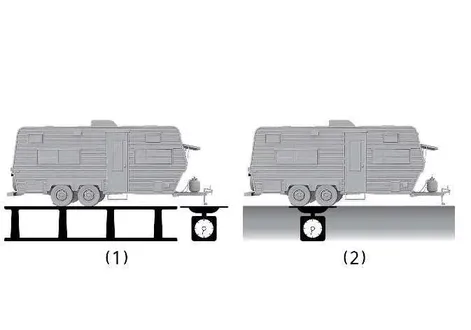
Weight of the trailer
|
|
The maximum safe towing weight should never exceed the designated maximum trailer weight limit for your Kia EV2, especially when accounting for trailer brakes. Even the maximum limit may prove too heavy depending on how you plan to use your trailer under specific driving conditions. For example, vehicle speed, driving altitude, steep road grades, ambient outside temperatures, and the frequency of your towing trips are all vital factors. The ideal operating trailer weight may also depend heavily on any special towing packages or accessories installed on your vehicle.
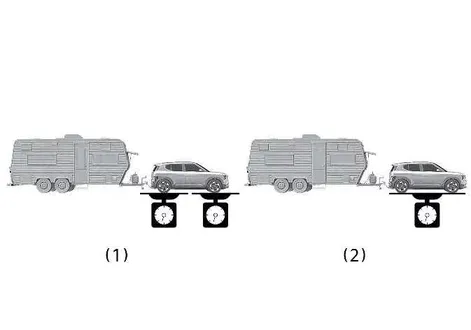
Weight of the trailer tongue
|
|
The tongue load of any trailer is a critical weight measurement because it directly impacts the total Gross Vehicle Weight (GVW) of your Kia EV2. This combined weight calculation includes the unladen kerb weight of your vehicle, any cargo stowed inside, and all passengers riding along. When towing a trailer, you must accurately add the downward tongue load to your total GVW because your vehicle's suspension and tyres are actively carrying that downward force.
As a rule of thumb, the trailer tongue should ideally weigh a maximum of 10% of the total loaded trailer weight, while remaining strictly within the authorized maximum trailer tongue load limits specified for your Kia EV2.
After loading your trailer, weigh the total trailer and the tongue load independently on a scale to verify that the distribution is correct. If the weights are out of specification, you can usually correct them by shifting cargo around inside the trailer to alter the center of gravity.
WARNING
Trailer
-
Never load a trailer with more weight concentrated in the rear than in the front. The front of the trailer should be loaded with approximately 60% of the total cargo weight, while the rear should carry approximately 40%.
-
Never exceed the maximum weight ratings or load limits established for your Kia EV2 and trailer towing equipment. Improper weight distribution can result in severe mechanical damage or serious personal injury. Always verify your exact weights and loading configuration using a certified commercial scale or a highway patrol weighing station.
-
An improperly or unevenly loaded trailer can drastically alter handling dynamics and cause you to completely lose control of your vehicle while driving.
 Maintenance when towing a trailer
Your Kia EV2 will naturally require more frequent professional servicing and inspection when you regularly engage in trailer towing. Key mechanical and electrical components that demand particular attention include the reducer oil, axle lubricants, thermal management cooling system fluids, and the overall condition of the brake pads and rotors...
 Vehicle weight
This comprehensive section offers vital guidance and instructions for properly loading your vehicle to ensure your loaded vehicle weight remains strictly within its engineered design rating capability...
Other information:
Kia EV2 (QV1, 2026-2026) Owner's Manual: Towing
Towing service Wheel dollies If towing is necessary for your Kia EV2, we strongly recommend having it done by an authorised Kia dealer or a commercial tow-truck service...
Chevrolet Silverado 2019-2026 Owners Manual: Infants and Young Children
Everyone in a vehicle needs protection! This includes infants and all other children. Neither the distance traveled nor the age and size of the traveler changes the need, for everyone, to use safety restraints. In fact, the law in every state in the United States and in every Canadian province says children up to some age must be restrained while in a vehicle...
Categories
- Manuals Home
- 4th Generation Silverado Owners Manual
- 4th Generation Silverado Service Manual
- Tire Chains
- Power Release Tailgate
- Programming Transmitters to the Vehicle
- New on site
- Most important about car
Power Door Locks
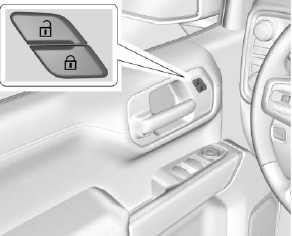
If equipped with power door locks.
 : Press to lock the doors.
