Kia EV2: Driving your vehicle / Trailer towing: (if equipped)
If you are considering towing a trailer with your vehicle, you should first check with your country's Department of Motor Vehicles (DMV) or local regulatory authorities to determine their exact legal requirements and licensing stipulations.
Since towing regulations vary significantly by region, the legal requirements for towing trailers, recreational equipment, or other types of vehicles and apparatus may differ. Always consult with a professional workshop before setting up your Kia EV2 for towing; Kia recommends visiting an authorised Kia dealer or service partner for certified guidance.
WARNING
Towing a trailer
If you drive improperly or fail to use the correct towing equipment, you can easily lose control of your Kia EV2 when towing a trailer. For example, if the attached trailer is excessively heavy, the vehicle braking system may not function with adequate stopping power. You, your passengers, and other motorists could suffer serious or fatal injuries as a result. Only tow a trailer if you have meticulously followed all safety steps outlined in this section.
WARNING
Weight limits
Before embarking on any towing journey with your Kia EV2, make absolutely sure that the total trailer weight, gross combination weight, gross vehicle weight, gross axle weight ratings, and trailer tongue load are all well within the manufacturer's specified limits.
NOTE
Trailer towing capability is not available on Light Trim vehicle variants.
NOTE
-
The technically permissible maximum load on the rear axles of your Kia EV2 may not exceed 15%, and the technically permissible maximum laden mass of your vehicle may not exceed 10% or 100 kg (220 lbs), whichever value is lower. Do not drive above 100 km/h (60 mph) for category M1 vehicles or 80 km/h (50 mph) for category N1 vehicles when towing.
-
When towing a trailer, the additional vertical load at the trailer coupling device may exceed the rear tyre maximum load ratings, but should never exceed 15%. Do not drive above 100 km/h (60 mph). Furthermore, the rear tyre pressure should be maintained at least 20 kPa (0.2 bar) above the recommended tyre pressure for normal vehicle operation without a trailer attached.
NOTE
Towing a trailer improperly can severely strain your Kia EV2 and result in costly mechanical repairs that are not covered under your manufacturer warranty. To tow a trailer correctly and safely, always follow the professional advice provided in this section.
Your Kia EV2 is engineered with the capability to tow a trailer when properly equipped. To identify the exact towing capacity and gross weight ratings specific to your vehicle configuration, refer to the section titled If you decide to tow a trailer.
Remember that towing a trailer introduces vastly different driving dynamics compared to operating your vehicle unladen. Towing a trailer means noticeable changes in vehicle handling, component durability, and overall energy efficiency. Successfully and safely towing a trailer requires the proper use of specialized, certified equipment.
This section contains many time-tested, essential tips and safety rules for trailer towing. Read this section carefully and thoroughly before attempting to hitch and tow a trailer.
Load-pulling components, such as the high-voltage power electric system, wheel bearing assemblies, and tyres, are forced to work much harder against the resistance and added weight of a trailer. The electric propulsion and thermal management systems are required to operate at relatively higher output levels under greater physical loads. This additional operational burden generates substantial extra heat. Furthermore, the attached trailer introduces considerable aerodynamic wind resistance, which significantly increases the total load-pulling requirements.
TIP
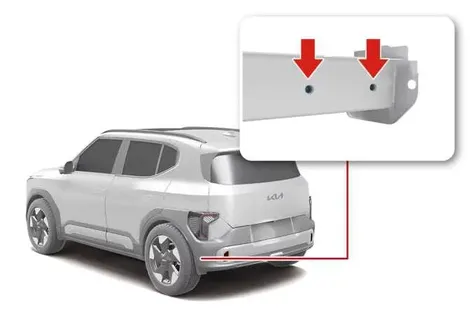
Location of trailer mounting
|
The structural mounting holes for secure trailer hitch installation are located on both sides of the underbody chassis directly behind the rear tyres.
- Hitches
- Safety chains
- Trailer brakes
- Driving with a trailer
- Maintenance when towing a trailer
- If you decide to tow a trailer
 Winter driving
Severe weather conditions and freezing temperatures in the winter result in greater tyre wear and various operational challenges for your vehicle. To minimise issues related to winter driving and protect your Kia EV2, you should carefully follow the professional suggestions outlined in these sections:
Snowy or icy conditions
To operate your Kia EV2 safely in deep snow, you may need to use dedicated snow tyres or install appropriate tyre chains on your wheels...
 Hitches
It is critically important to use the correct trailer hitch equipment on your Kia EV2. Strong crosswinds, turbulence from large passing trucks, and rough road surfaces are just a few reasons why having the right frame-mounted hitch is essential...
Other information:
Chevrolet Silverado 2019-2026 Owners Manual: Editing a Trailer Profile
Trailer Profile View Touch to edit any of the following options in the Trailer Profile view: Trailer Name Towing Assistance Setup Tire Pressure Setup Trailer Maintenance Mileage Average Fuel Economy Reverse Lights Alert Electric Brakes Alert Touch Save to save the new value to the Trailer Profile...
Kia EV2 (QV1, 2026-2026) Owner's Manual: Light bulb position (Rear)
Figure 1. Rear combination lamp (Type A) Figure 2...
Categories
- Manuals Home
- 4th Generation Silverado Owners Manual
- 4th Generation Silverado Service Manual
- Head-Up Display (HUD)
- Tire Chains
- Instrument Panel Fuse Block (Left)
- New on site
- Most important about car
Rear Camera Mirror
If equipped, this automatic dimming mirror provides a wide angle camera view of the area behind the vehicle.