
Kia EV2: Driving your vehicle / Vehicle weight
This comprehensive section offers vital guidance and instructions for properly loading your vehicle to ensure your loaded vehicle weight remains strictly within its engineered design rating capability. Properly and evenly loading your Kia EV2 maximizes its optimal design performance, structural longevity, and active driving safety. Before loading cargo or passengers into your vehicle, familiarize yourself thoroughly with the following essential terminology used for determining your vehicle's weight ratings, derived directly from your vehicle's technical specifications and the official certification label:
Base kerb weight
This is the baseline weight of your vehicle, including the high-voltage battery system and all standard equipment. It does not include passengers, cargo, or any aftermarket optional equipment.
Vehicle kerb weight
This is the actual measured weight of your new Kia EV2 when you picked it up from your authorized dealer, plus the weight of any installed aftermarket accessories or equipment.
Cargo weight
This encompasses all weight added on top of the Base kerb weight, including luggage, transported goods, and any optional equipment.
GAW (Gross axle weight)
This represents the total downward gravitational weight placed on each individual axle (front and rear), which includes the respective share of the vehicle kerb weight, cargo load, and vehicle occupants.
GAWR (Gross axle weight rating)
This defines the maximum allowable weight capacity that a single axle (either front or rear) is certified to carry. These critical safety numbers are clearly indicated on the official vehicle certification label (if equipped).
The total accumulated load resting on each axle must never exceed its designated GAWR.
GVW (Gross vehicle weight)
This is calculated as the Base kerb weight plus the actual Cargo weight plus the combined weight of all passengers on board your Kia EV2.
GVWR (Gross vehicle weight rating)
This is the maximum allowable total weight limit of the fully loaded vehicle, which includes all options, factory equipment, passengers, and cargo combined. The official certification label (if equipped) located on the driver side or front passenger side door sill clearly displays the GVWR.
Overloading
WARNING
Vehicle weight
The gross axle weight rating (GAWR) and the gross vehicle weight rating (GVWR) for your Kia EV2 are listed on the official certification label attached to the vehicle door pillar. Exceeding these engineering ratings can cause a dangerous traffic accident or permanent mechanical damage to your vehicle. You can accurately calculate your load weight by weighing individual items and passengers before putting them into your vehicle. Always remain vigilant and never overload your Kia EV2.
Loading Your Vehicle: (if equipped)
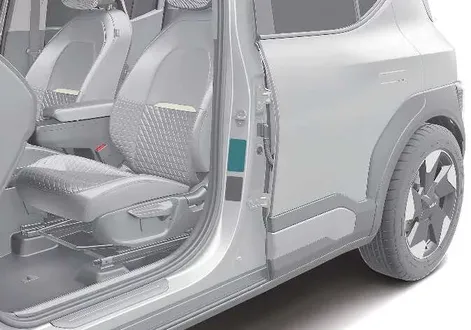
|
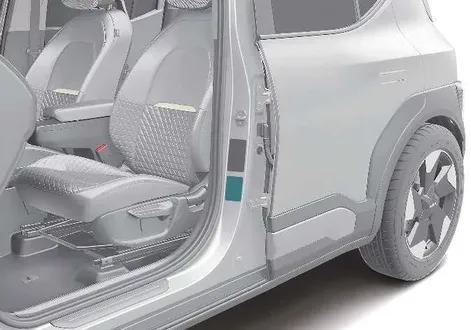
|
The Certification and Tyre specification label is conveniently located on the front edge of the right-hand or left-hand "B" pillar. This essential label displays the exact size of your original factory tyres and the precise cold inflation pressures needed to attain the full gross weight capacity of your Kia EV2.
Never exceed the GVWR for your vehicle, or the Gross Axle Weight Rating (GAWR) for either the front or the rear axle. Furthermore, whenever you carry a heavy load, you should distribute it evenly throughout the cabin and cargo area. Please note that manufacturer warranties do not cover parts or structural components that fail prematurely as a result of chronic vehicle overloading.
Do not load your Kia EV2 any heavier than its rated GVWR or the maximum front and rear GAWR limits. Doing so can negatively alter vehicle dynamics and change the way your vehicle handles on the road, potentially causing you to lose directional control. Additionally, severe overloading accelerates wear and tear, shortening the operational life span of your vehicle.
 If you decide to tow a trailer
Important points to keep in mind if you decide to tow a trailer with your Kia EV2:
Consider installing an electronic sway control system for enhanced stability...
 Driver assistance guide
WARNING
As the driver, do not rely blindly on the advanced Driver Assistance Systems equipped on your Kia EV2. These automated systems do not replace the absolute necessity for maintaining constant attention and practicing safe driving habits...
Other information:
Kia EV2 (QV1, 2026-2026) Owner's Manual: Armrest (5 seats) : (if equipped)
To use the fold-down center armrest in your Kia EV2, pull it gently forward out from the center of the rear seatback until it rests horizontally...
Kia EV2 (QV1, 2026-2026) Owner's Manual: Smart Cruise Control malfunction
Check Driver Assistance system When Smart Cruise Control is not working properly, the Master warning light () appears on the instrument cluster, along with a warning message that lasts for several seconds...
Categories
- Manuals Home
- 4th Generation Silverado Owners Manual
- 4th Generation Silverado Service Manual
- Heated Steering Wheel
- Maintenance Schedule
- Driver Information Center (DIC) (Midlevel and Uplevel)
- New on site
- Most important about car
Power Mirrors
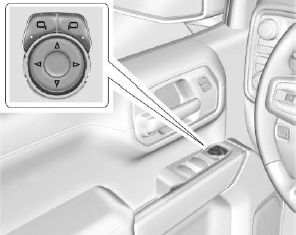
To adjust each mirror:
Press  or
or
 to select the driver or passenger side
mirror. The indicator light will illuminate.
to select the driver or passenger side
mirror. The indicator light will illuminate.
