
Chevrolet Silverado: Service and Maintenance / Special Application Services
Chevrolet Silverado 2019-2026 Owners Manual / Service and Maintenance / Special Application Services
- Vehicles with Dual Wheels: Check dual wheel nut torque at 160, 1 600, and 10 000 km (100, 1,000, and 6,000 mi) of driving. Repeat this service whenever a tire/wheel is serviced or removed.
- Severe Commercial Use Vehicles Only: Lubricate chassis components every oil change.
- Have underbody flushing service performed. See “Underbody Maintenance” in Exterior Care.
 Additional Required Services
Footnotes — Maintenance Schedule Additional Required Services - Normal
(1) Or every two years, whichever comes first. More frequent replacement
may be needed if the vehicle is driven in areas with heavy traffic, poor air quality,
areas with high dust levels or are sensitive to environmental allergens...
 Additional Maintenance and Care
Your vehicle is an important investment and caring for it properly may help to
avoid future costly repairs. To maintain vehicle performance, additional maintenance
services may be required...
Other information:
Kia EV2 (QV1, 2026-2026) Owner's Manual: Special driving conditions
In poor weather or challenging road conditions, you should always drive your Kia EV2 even more carefully than usual to maintain total control. Hazardous driving conditions When you encounter standing water, snow, ice, mud, deep sand, or similar environmental hazards on the road, follow these expert suggestions: Drive cautiously and allow significantly extra distance for braking your Kia EV2...
Kia EV2 (QV1, 2026-2026) Owner's Manual: Door lock/unlock features : (if equipped)
Your Kia EV2 is engineered with advanced automated door locking and unlocking features designed to maximize both passenger safety and everyday operational convenience. Impact sensing door unlock system All cabin doors will automatically unlock if a severe collision impact causes the vehicle airbags to deploy while your Kia EV2 power system is active and not in the OFF position...
Categories
- Manuals Home
- 4th Generation Silverado Owners Manual
- 4th Generation Silverado Service Manual
- Instrument Panel Fuse Block (Right)
- Power Seat Adjustment
- Folding Mirrors
- New on site
- Most important about car
Blind Spot Mirrors
If equipped, there is a small convex mirror built into the upper and outer corner of the driver outside mirror. It can show objects that may be in the vehicle's blind zone.
Driving with the Blind Spot Mirror
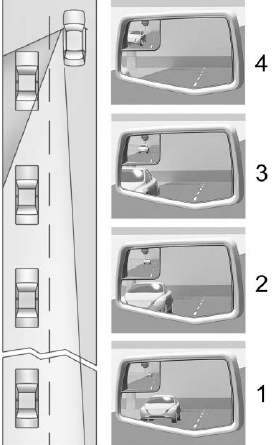
Actual Mirror View
When the approaching vehicle is a long distance away, the image in the main mirror is small and near the inboard edge of the mirror. As the vehicle gets closer, the image in the main mirror gets larger and moves outboard. As the vehicle enters the blind zone, the image transitions from the main mirror to the blind spot mirror. When the vehicle is in the blind zone, the image only appears in the blind spot mirror.
Copyright © 2026 www.chsilverado.com