Kia EV2: Forward Collision-Avoidance Assist operation / Evasive Steering Assist function: (if equipped)
The advanced Evasive Steering Assist functionality integrated into the comprehensive Forward Collision-Avoidance Assist architecture of your Kia EV2 is Emergency Steering.
Emergency Steering (Driver steering assist)
|
|
Emergency Steering can alert you with Emergency steering warning light blinking ( ), a warning message, an audible warning, and steering wheel vibration.
If there is a risk of a collision with another vehicle or a pedestrian, cyclist, or motorcyclist ahead of your vehicle, Emergency Steering can assist you in steering to help prevent a collision.
Emergency steering will be activated in following conditions.
Your driving speed: Approximately 40–85 km/h (25–53 mph)
Emergency Steering (Evasive steering assist)
|
|
|
Emergency Steering can alert you with Emergency steering warning light blinking (), a warning message, an audible warning, and steering wheel vibration.
If there is a risk of a collision with a pedestrian, cyclist, or motorcyclist ahead of your vehicle and you have already exceeded the Emergency Braking speed limit, Emergency Steering can activate to help you avoid a collision.
Emergency Steering may activate under following conditions:
-
Emergency Steering can activate when your driving speed is approximately 65-75 km/h (40-47 mph).
-
The direction of travel of a pedestrian, cyclist, or motorcycle is the same as or opposite to the driving direction of your vehicle.
-
Both lanes are detected.
-
Driving on a straight lane.
-
There is no risk of a secondary collision.
CAUTION
-
When Emergency Steering is operating, the steering wheel may turn automatically.
-
Emergency Steering automatically ends when risk factors disappear. Adjust the steering wheel as needed.
-
Emergency Steering may deactivate during operation if the steering wheel is held tightly or steered in the opposite direction.
-
When steering is assisted to avoid a collision with another vehicle, a pedestrian, or a cyclist, Evasive steering assist will deactivate if potential collisions are detected with other vehicles, motorcyclist, pedestrians, or cyclists.
-
Evasive steering assist may not operate if there is insufficient space to avoid a collision.
-
When driving at night, the performance of powered two-wheeler recognition is decreased, so the Forward Collision-Avoidance Assist system may be temporarily limited or may not work.
TIP
For more information about warning messages, refer to Collision Warning.
WARNING
-
For your safety, change the settings only after parking the vehicle at a safe location.
-
Forward Collision-Avoidance Assist does not operate in all situations and cannot avoid all collisions.
-
You are responsible for controlling the vehicle. Do not depend on Forward Collision-Avoidance Assist. Maintain a safe braking distance and manually engage the brake pedal to reduce driving speed or stop the vehicle.
-
Never deliberately drive toward people or objects to test Forward Collision-Avoidance Assist. It may cause serious injury or death.
-
Forward Collision-Avoidance Assist may not operate, if the driver applies the brake pedal to decelerate and exits a collision-risk situation.
-
Depending on the road and driving conditions, Forward Collision-Avoidance Assist may warn you late or not at all.
-
During Forward Collision-Avoidance Assist operation, the vehicle may stop suddenly, which can cause loose objects to shift and possibly injure passengers. Always fasten seat belts and secure loose objects.
-
Forward Collision-Avoidance Assist may not display a warning message or generate an audible warning if any other function’s warning message is displayed or any other function’s audible warning is generated at the same time.
-
You may not hear the warning sound of Forward Collision-Avoidance Assist if you are in noisy surroundings.
-
Depending on road conditions and surroundings, Forward Collision-Avoidance Assist may turn OFF or operate improperly or unnecessarily.
-
Even if there is a malfunction in Forward Collision-Avoidance Assist, braking by pressing the brake pedal operates normally.
-
Emergency Braking activated by Forward Collision-Avoidance Assist may end automatically if you brake hard or turn the steering wheel sharply.
CAUTION
-
Your surroundings may affect the speed or detection range of Forward Collision-Avoidance Assist, and result in the function being temporarily limited or disabled.
-
Forward Collision-Avoidance Assist takes into account the oncoming vehicle’s direction, speed, and surroundings to judge risk.
-
Forward Collision-Avoidance Assist may not activate when driving at a high speed or when there is a significant difference in speed between your vehicle and oncoming vehicles.
-
If the system determines that a collision with surrounding vehicles is likely, the Lane Change Oncoming, Lane Change Side, and Evasive Steering Assist functions will provide warnings only and not steering control.
TIP
-
When a collision is imminent, Forward Collision-Avoidance Assist may activate brake assist if you do not brake enough to avoid the collision.
-
The images or colours may display differently depending on the specifications of the instrument cluster or theme.
-
Forward Collision-Avoidance Assist may operate at an earlier timing, If the in-cabin camera determines that the driver’s condition is abnormal.: (if equipped)
 Lane-Change Side function: (if equipped)
The advanced Lane-Change Side functional capabilities integrated into the comprehensive Forward Collision-Avoidance Assist architecture of your Kia EV2 comprise:
Collision Warning
Emergency Steering
Collision Warning
Collision Warning
Collision Warning can alert you with the emergency steering warning light blinking (), a warning message, an audible warning, and steering wheel vibration...

Other information:
Kia EV2 (QV1, 2026-2026) Owner's Manual: Highway Driving Assist settings
Driver Assistance Driving Convenience Highway Driving Assist Whilst your vehicle is ON, tap Setup > Vehicle > Driver Assistance > Driving Convenience on the infotainment touchscreen of your Kia EV2 to configure personalized preferences for each individual function...
Kia EV2 (QV1, 2026-2026) Owner's Manual: Countermeasures for accidents or fire
If an unexpected collision or emergency occurs while driving your Kia EV2, execute the following critical containment steps immediately: Activate the emergency hazard warning lights and carefully guide the Kia EV2 to a secure location off active traffic lanes...
Categories
- Manuals Home
- 4th Generation Silverado Owners Manual
- 4th Generation Silverado Service Manual
- Power Outlets
- Heated Steering Wheel
- Tire Chains
- New on site
- Most important about car
Keys (Key Access)
Warning
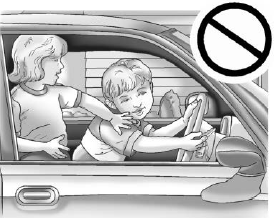
Leaving children in a vehicle with the ignition key is dangerous and children or others could be seriously injured or killed. They could operate the power windows or other controls or make the vehicle move. The windows will function with the keys in the ignition, and children or others could be caught in the path of a closing window. Do not leave children in a vehicle with the ignition key.