
Kia EV2: Blind-Spot Collision-Avoidance Assist (BCA): (if equipped) / Blind-Spot Collision-Avoidance Assist operation
Blind-Spot Collision-Avoidance Assist operates as follows:
-
Collision Warning (whilst driving)
-
Collision-Avoidance Assist (whilst departing)
Collision Warning (whilst driving)
|
The warning light on the instrument cluster, outside rearview mirror, and head-up display (if equipped) appear when a vehicle in either of the surrounding lanes is detected from the rear.
A vehicle is detected in the following conditions:
-
Your speed is above 20 km/h (12 mph).
-
The speed of the vehicle in your blind spot is above 10 km/h (7 mph).
-
The detected object enters the warning area.
With vehicle detection in use, Collision Warning will alert you when you activate the turn signal to make a lane change whilst there is a car in your blind spot.
-
Collision warning will alert you with the warning lights on the instrument cluster, outside rearview mirror, and heads-up display (if equipped), an audible warning, and steering wheel vibration.
-
When you turn OFF the turn signal or move away from the lane, the collision warning cancels, and the function returns to vehicle detection state.
Collision Warning operates under the following conditions:
-
Your speed is above 40 km/h (25 mph).
-
The speed of the vehicle in your blind spot is above 10 km/h (7 mph).
-
The detected object enters the warning area and the turn signal in the same direction is activated.
WARNING
-
The detecting range of the front or rear corner radar is determined by a standard road width. Therefore, on a narrow road, Blind-Spot Collision-Avoidance Assist may detect other vehicles 2 lanes over and warn you. In contrast, on a wide road, Blind-Spot Collision-Avoidance Assist may not be able to detect a vehicle driving in the next lane and may not warn you.
-
When the hazard warning flasher is ON, the collision warning next to the turn signal will not operate.
TIP
-
If the driver’s seat is on the left side, the collision warning may occur when you turn left. If the driver’s seat is on the right side, the collision warning may occur when you turn right. Maintain a proper distance with the vehicles in the lane.
-
The images or colours may display differently depending on the specifications of the instrument cluster or theme.
Collision-Avoidance Assist (whilst departing)
|
|
|
The warning light on the outside rearview mirror, head-up display (if equipped), an audible warning, and steering wheel vibration warn you of a potential collision. This advanced safety function built into your Kia EV2 actively assists in precise braking control to prevent a side collision with a vehicle approaching rapidly from your blind spot.
Collision-Avoidance Assist activates in the following conditions:
-
Your speed is below 3 km/h (2 mph).
-
The speed of the vehicle in your blind spot is above 5 km/h (3 mph).
-
The gear position is other than R (Reverse) or P (Park).
-
A collision with the operating target is predicted.
|
|
When the vehicle is stopped due to Emergency Braking, a warning message appears on the instrument cluster of your Kia EV2. For your safety, engage the brake pedal immediately and check the surrounding traffic environment carefully.
Brake control ends approximately 2 seconds after Emergency Braking successfully brings your vehicle to a complete stop.
WARNING
-
Collision-Avoidance Assist will be cancelled in the following situations:
-
The vehicle moves a certain distance into an adjacent lane.
-
The vehicle moves out of the collision risk direction.
-
The steering wheel is turned abruptly.
-
The brake pedal is applied.
-
Forward Collision-Avoidance Assist is activated.
-
-
For your safety, change the settings only after parking the vehicle at a safe location.
-
Blind-Spot Collision Avoidance may not display a warning message or generate an audible warning if any other function’s warning message is displayed or audible warning is generated at the same time.
-
You may not hear the warning sound of Blind-Spot Collision-Avoidance Assist if your surroundings are noisy. Always pay attention and keep volume within the vehicle at a moderate level.
-
Blind-Spot Collision-Avoidance Assist may not operate if you engage the brake pedal to avoid a collision.
-
When Blind-Spot Collision-Avoidance Assist is operating, the function’s braking control cancels automatically when you excessively engage the accelerator pedal or sharply steer the vehicle.
-
During Blind-Spot Collision-Avoidance Assist operation, the vehicle may stop suddenly, injuring passengers and shifting loose objects. Always fasten the seat belts and keep loose objects secured.
-
If there is a problem with Blind-Spot Collision-Avoidance Assist, the vehicle’s basic braking performance will operate properly.
-
Blind-Spot Collision-Avoidance Assist may not operate in all situations, and even if it works, may not be able to avoid collisions.
-
Blind-Spot Collision-Avoidance Assist may warn you late or not at all, depending on the road and driving conditions.
-
You are responsible for safe operation of the vehicle. Do not rely solely on Blind-Spot Collision-Avoidance Assist for driving. Always check your surroundings and drive safely.
-
Never rely solely on Blind-Spot Collision-Avoidance to avoid a collision with people, animals, or objects. It may cause serious injury or death.
WARNING
Brake control may not operate properly depending on the status of Electronic Stability Control (ESC).
There will only be a warning when:
-
The ESC warning light is illuminated.
-
ESC is engaged in a different function.
 Blind-Spot Collision-Avoidance Assist settings
Blind-Spot Safety
Driver Assistance
Driving Safety
Blind-Spot Safety
Whilst the vehicle is ON, tap Setup > Vehicle > Driver Assistance > Driving Safety > Blind-Spot Safety on the infotainment system screen of your Kia EV2...
 Blind-Spot Collision-Avoidance Assist malfunction and limitations
Blind-Spot Collision-Avoidance Assist malfunction
Check Driver Assistance system...
Other information:
Chevrolet Silverado 2019-2026 Owners Manual: Hill and Mountain Roads
Driving on steep hills or through mountains is different than driving on flat or rolling terrain. Tips include: Keep the vehicle serviced and in good shape. Check all fluid levels and brakes, tires, cooling system, and transmission. Shift to a lower gear when going down steep or long hills...
Chevrolet Silverado 2019-2026 Owners Manual: Remote Keyless Entry (RKE) System Operation (Key Access)
The RKE transmitter functions may work up to 60m (197 ft) away from the vehicle. Other conditions can affect the performance of the transmitter. See Remote Keyless Entry (RKE) System. : Press and release , then immediately press and hold until the turn signal lamps flash or for at least four seconds...
Categories
- Manuals Home
- 4th Generation Silverado Owners Manual
- 4th Generation Silverado Service Manual
- E85 or FlexFuel
- Folding Mirrors
- Electric Parking Brake
- New on site
- Most important about car
Vehicle Alarm System
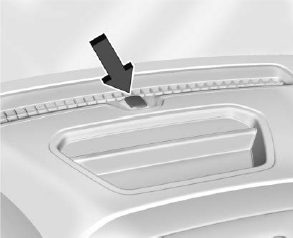
The indicator light, on the instrument panel near the windshield, indicates the status of the system.
