Kia EV2: Driving electric vehicle / Distance to empty. Impact on distance to empty
Impact on distance to empty
The vehicle displays the distance to empty differently according to the drive mode selected in the drive mode integrated control system of your Kia EV2.
For more information, see the list below.
-
Driving range depends on your driving style, the vehicle’s electrical load usage, the environment, and the high voltage battery charge level. These effects might cause the distance to empty displayed on your Kia EV2 to be higher or lower than the certification range.
-
Driving style refers to your driving speed and your acceleration and deceleration tendencies. The higher the speed, or the more frequently you accelerate and decelerate, the more the distance to empty decreases.
-
Electrical load usage means air conditioning, heaters, lamps, or additional auxiliary loads. As the usage increases, the distance to empty decreases.
-
Environment refers to weather, temperature, and terrain. The distance to empty decreases in cases of snow, rain, high winds, low temperatures, and uphill, slippery, or rough road surfaces.
-
High voltage battery energy is proportional to SOC (charge amount), but might vary depending on the battery temperature, SOH (battery health), and so on.
Change of distance to empty when 100% charging
-
If the distance to empty decreases whilst the vehicle learns your driving style or due to the environment in which you use your Kia EV2, the driving distance might increase again if you drive according to the "driving tips for improving the driving distance". You can have the distance to empty reset at a workshop, but this does not actually increase the range. Therefore, the distance to empty might be inaccurate until the vehicle learns your driving style.
-
Distance to empty decreases when the high voltage battery temperature is low in winter. This is not a permanent change. If the temperature rises, the distance to empty increases again.
-
Reducing the use of electrical loads increases the available range.
-
The longer you use the vehicle, the more the high voltage battery naturally degrades, which reduces the distance to empty.
Operating tips to improve driving range
-
As electric vehicles speed up, air resistance increases rapidly, so not speeding helps increase your driving range.
-
Rapid acceleration consumes significant driving energy. Rapid deceleration restricts motor regenerative braking. Keep your speed and the engagement of the accelerator pedal constant.
-
Excessively operating the heater and air conditioner can increase power consumption and shorten the driving range. Setting the temperature to 22°C (72°F)
AUTOleads to optimal energy consumption whilst driving. Using a heated seat and reducing air heating in winter is very helpful. Turn off the heater and air conditioner when you do not need to heat or cool the vehicle. -
Selecting recirculation mode consumes less energy than selecting fresh mode. Fresh mode consumes significant energy because the vehicle must reheat or cool air from outside. Driving with the window open increases air resistance and heater and air conditioner use. To reduce energy consumption, close the window completely whilst driving.
-
When driving alone, use DRIVER ONLY mode for the heater and air conditioner.
-
Always maintain the specified tyre pressure and use tyres made specifically for electric vehicles.
-
Do not use unnecessary electrical components whilst driving.
-
Do not load unnecessary items in the vehicle.
-
Do not mount parts that might increase air resistance.
 Stopping the vehicle
Park the vehicle and engage and hold the brake pedal.Shift the gear to P (Park).Apply the parking brake.Press the EV button to turn your Kia EV2 OFF.Check to make sure the READY indicator light is off and the parking brake symbol displays on the instrument cluster...
 EV Economy History. Electricity Use
You can check the history of energy consumption with the date and distance of the last time you drove...
Other information:
Kia EV2 (QV1, 2026-2026) Owner's Manual: Hill-start Assist Control (HAC)
A vehicle has the tendency to roll backward when it starts moving after you have stopped it on a steep hill. The HAC system prevents your Kia EV2 from rolling backward by engaging the brakes automatically for about 2 seconds. The HAC system releases the brakes after about 2 seconds, or when you engage the accelerator pedal...
Chevrolet Silverado 2019-2026 Owners Manual: Exterior Care
Locks Locks are lubricated at the factory. Use a de-icing agent only when absolutely necessary, and have the locks greased after using. See Recommended Fluids and Lubricants. Washing the Vehicle To preserve the vehicle's finish, wash it often and out of direct sunlight...
Categories
- Manuals Home
- 4th Generation Silverado Owners Manual
- 4th Generation Silverado Service Manual
- Driver Information Center (DIC) (Base Level)
- Head-Up Display (HUD)
- Electronic Stability Control (ESC) Off Light
- New on site
- Most important about car
Keys (Key Access)
Warning
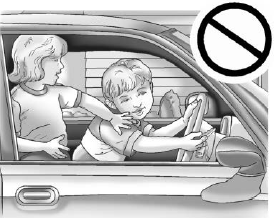
Leaving children in a vehicle with the ignition key is dangerous and children or others could be seriously injured or killed. They could operate the power windows or other controls or make the vehicle move. The windows will function with the keys in the ignition, and children or others could be caught in the path of a closing window. Do not leave children in a vehicle with the ignition key.