
Kia EV2: Child Restraint System (CRS) / Selecting a Child Restraint System (CRS). Child restraint system types
When selecting a suitable Child Restraint System for your child to use in your Kia EV2, always follow these guidelines:
-
Make sure the Child Restraint System features an official label certifying that it meets the applicable Safety Standards of your country.
A Child Restraint System may only be installed if it was approved in accordance with the strict regulatory requirements of ECE-R44, ECE-R129, or another relevant safety regulation.
-
Select a Child Restraint System based precisely on your child's current height and weight. The required certification label or the manufacturer's instructions for use typically provide this vital sizing information.
-
Select a Child Restraint System that physically fits the vehicle seating position where it will be installed and used.
For detailed information regarding the suitability of Child Restraint Systems on your vehicle's specific seating positions, please refer to the section covering securing a Child Restraint System with a lap/shoulder belt.
-
Read, understand, and comply fully with all the warnings and instructions for installation and use provided with the Child Restraint System.
Child restraint system types
There are three main types of Child Restraint Systems available for use within your Kia EV2:
-
Rearward-facing CRS
-
Forward-facing CRS
-
Booster seat
These specialized safety devices are meticulously classified and selected according to the child's specific age, height, and weight milestones.
Rearward-facing Child Restraint System
|
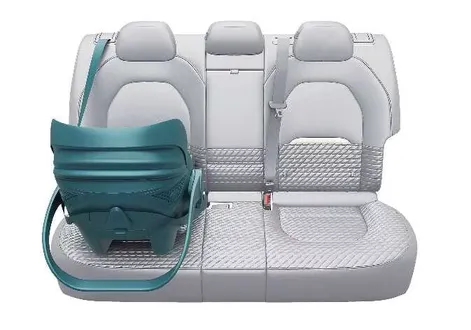
A rearward-facing Child Restraint System provides comprehensive support with the seating surface against the back of the child. The integrated harness system holds the child securely in place, and in the event of a sudden collision or impact, acts to keep the child properly positioned within the Child Restraint System while significantly reducing mechanical stress to their fragile neck and spinal cord.
All infants under the age of one year must always ride in a rearward-facing Child Restraint System. There are different types of rearward-facing Child Restraint Systems: infant-only Child Restraint Systems can exclusively be used in the rearward-facing configuration, whereas convertible and 3-in-1 Child Restraint Systems typically feature higher height and weight limits for the rearward-facing position, allowing you to keep your child facing backward for a longer period of time.
Keep using Child Restraint Systems in the rearward-facing position as long as your children comfortably fit within the specific height and weight limits outlined by the Child Restraint System's manufacturer.
Forward-facing Child Restraint System
|
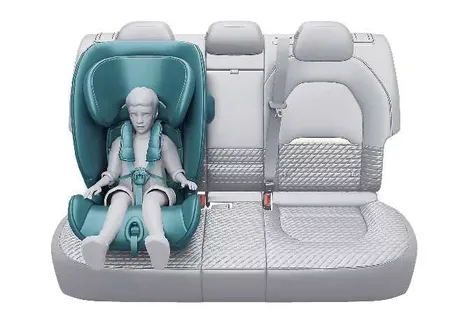
A forward-facing Child Restraint System provides secure restraint for the child's growing body using a dedicated harness system. Keep children traveling in a forward-facing Child Restraint System with a harness until they reach the maximum height or weight limit permitted by your Child Restraint System's manufacturer.
Once your child has outgrown the physical dimensions of the forward-facing Child Restraint System, your child is officially ready to transition to a booster seat.
Booster seats
A booster seat is a specialized Child Restraint System designed specifically to improve the anatomical fit of the vehicle's seat belt system. A booster seat correctly positions the standard seat belt so that it rests properly over the stronger skeletal parts of your child's body. Keep your children seated in booster seats until they are physically big enough to fit into a standard vehicle seat belt properly on their own.
For a seat belt to fit properly inside your Kia EV2, the lap belt must lie comfortably across the upper thighs rather than across the sensitive stomach area. The shoulder belt should rest comfortably across the center of the shoulder and chest, avoiding the neck or face entirely. Children under the age of 13 must always be properly restrained in the rear to minimize the risk of injury during an accident, sudden stop, or sudden evasive maneuver.
 Using a Child Restraint System (CRS)
Infants and younger children must be restrained in an appropriate rearward-facing or forward-facing CRS that has first been properly secured to the seat of the vehicle...
 Installing a Child Restraint System (CRS)
WARNING
Before installing your Child Restraint System inside your Kia EV2, always:
Read, understand, and carefully follow the precise instructions provided by the manufacturer of the Child Restraint System...
Other information:
Kia EV2 (QV1, 2026-2026) Owner's Manual: AI Assistant
The intelligent AI Assistant built into your Kia EV2 can be effortlessly operated using advanced voice recognition technology, allowing you to control cabin settings and retrieve information hands-free...
Kia EV2 (QV1, 2026-2026) Owner's Manual: In case of an emergency
If the electrical power door lock switches fail to function—such as in the event of a discharged vehicle battery—the only way to secure the doors is by using the mechanical key in the exterior key cylinder. Doors that lack an external key cylinder can be manually secured using the emergency latch procedure: Open the target door fully...
Categories
- Manuals Home
- 4th Generation Silverado Owners Manual
- 4th Generation Silverado Service Manual
- Lower Anchors and Tethers for Children (LATCH System)
- Head-Up Display (HUD)
- Programming Transmitters to the Vehicle
- New on site
- Most important about car
Blind Spot Mirrors
If equipped, there is a small convex mirror built into the upper and outer corner of the driver outside mirror. It can show objects that may be in the vehicle's blind zone.
Driving with the Blind Spot Mirror
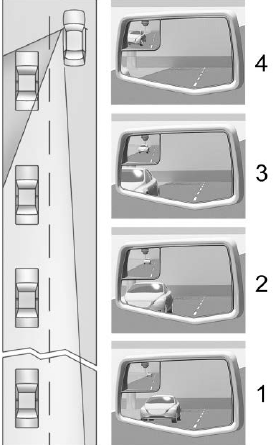
Actual Mirror View
When the approaching vehicle is a long distance away, the image in the main mirror is small and near the inboard edge of the mirror. As the vehicle gets closer, the image in the main mirror gets larger and moves outboard. As the vehicle enters the blind zone, the image transitions from the main mirror to the blind spot mirror. When the vehicle is in the blind zone, the image only appears in the blind spot mirror.